
The Philippines is experiencing an escalating climate crisis as the country’s political and economic systems, dominated by vested interests, exacerbate the impact of climate change. The OECD, in its 2026 economic survey on the country, reports more intense and frequent typhoons, accelerated sea-level rise, and more extreme rainfall events. All these pose grave risks and costs to business, infrastructure, communities, people’s livelihoods, properties, and ecosystems–with the poor and vulnerable sectors suffering the greatest hardships.
The Ecological and Economic Reality of Extractive Mining
On July 10, 2026, the Center for Environmental Concerns (CEC) – Philippines and IBON Foundation organized a forum titled “Plundered, Not Poor: State of the Philippine Environment 2026.” The event highlighted the country’s decreasing forest cover: from 2001 to 2025, the Philippines lost 1.6 million hectares of trees, leaving only 24% of the nation’s land area forested. CEC pointed to mining as a primary driver of this deforestation, citing 58,967.3 approved permits alongside 1.9 million hectares under unpermitted operations.
Despite this immense ecological toll, the economic returns are minimal. Data from the Philippine Statistics Authority show that mining and quarrying contributed a mere 0.95% to the country’s Gross Domestic Product (GDP) in 2023 and employed less than 0.5% of the national workforce – a sector projected to account for only 2% of GDP by 2028.
Foreign Geopolitics and Domestic Policy Agreement
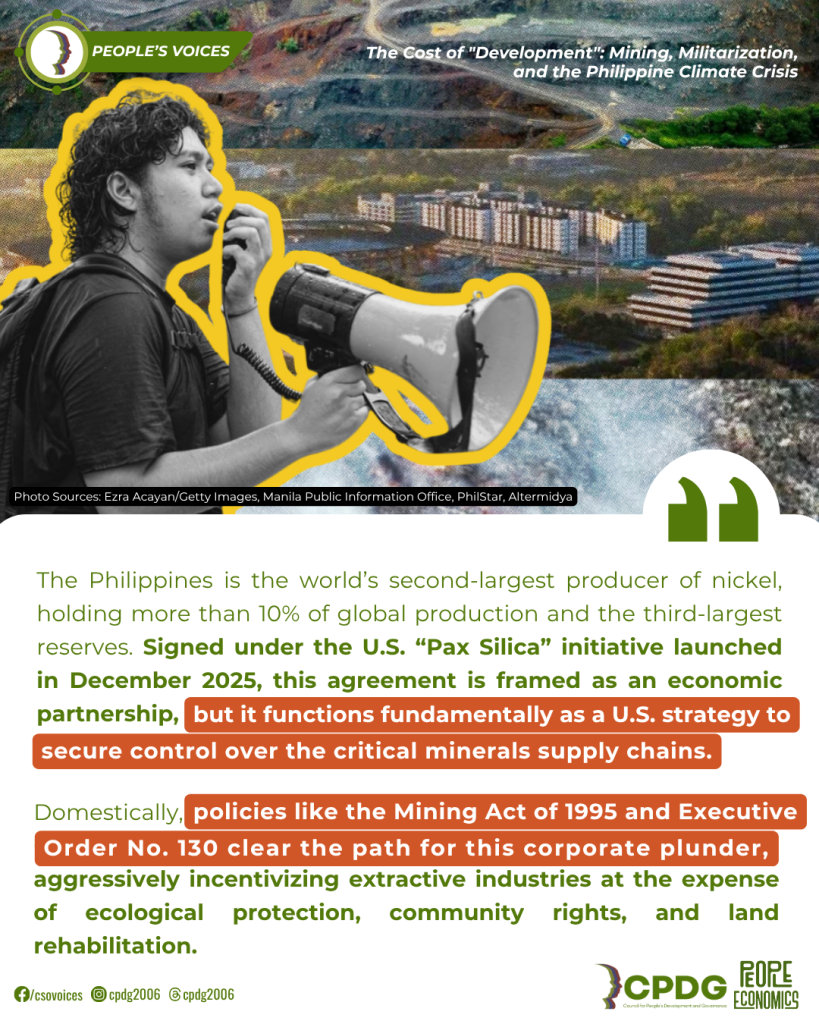
Seeking to expand this sector, the Department of Environment and Natural Resources (DENR) signed a memorandum of understanding with the United States on February 4, 2026, to support local processing of the country’s critical minerals and rare earth sector. The Philippines is the world’s second-largest producer of nickel, holding more than 10% of global production and the third-largest reserves. Signed under the U.S. “Pax Silica” initiative launched in December 2025, this agreement is framed as an economic partnership, but it functions fundamentally as a U.S. strategy to secure control over the critical minerals supply chains.
Domestically, policies like the Mining Act of 1995 and Executive Order No.130 clear the path for this corporate plunder, aggressively incentivizing extractive industries at the expense of ecological protection, community rights, and land rehabilitation. These policies directly enable destructive, large-scale mining operations–such as the exploration projects of UK-based Woggle Corporation (a subsidiary of FCF Minerals) in Dupax del Norte, and North Luzon Mineral Resources Corporation (NLMRC) in Kasibu, Nueva Viscaya–both of which face intense local opposition.
Agrarian Insecurity and “False Solutions” to Climate Vulnerability
This focus on corporate extraction directly worsens climate vulnerability across both rural and urban communities. Systematic landlessness remains a primary driver of this exposure, with government data revealing that 72% of farmers owned no land from 2012 to 2022. This widespread insecurity left agricultural workers highly vulnerable when consecutive typhoons and El Niño caused agricultural damage to skyrocket to ₱60 billion in 2024. Rather than providing direct relief or structural land reform, the state responded with debt-inducing loan programs, including a $1 billion loan from the World Bank in 2025.
Compounding this agrarian crisis is the continuous conversion of declining farmlands and forests into commercial and residential use, industrial estates, and large-scale infrastructure like mega-dams and coastal reclamation.
In Metro Manila, corporate-led “waste-to-energy (WTE)” initiatives act as false solutions that directly threaten to displace the urban poor. Recent landfill tragedies highlight how the profit-driven nature of these waste facilities strips marginalized communities of a healthy environment alongside their fundamental civil and political rights.
State Repression and the Defense of Rights
Because these top-down projects face widespread community resistance, the state relies on systematic repression to enforce them. In his first SONA in 2022–just weeks into his term–President Marcos Jr. laid out an economic agenda centering on renewable energy, reclamation schemes, large dams, and large-scale mining as key pathways to development. Yet, four years in, the result of these policies is worsening profit-driven environmental degradation, enabled by political dynasties and systemic corruption.
At the frontlines of this destruction are civil society organizations, environmental defenders, and development workers. Across the country, development workers providing humanitarian aid and relief, providing skills training and building capacity of communities are being red-tagged, harassed, and criminalized despite their contributions to development and advancing people’s welfare. They face trumped-up charges, illegal arrests, digital surveillance, and state-sponsored attacks.
When civil society and frontline communities speak out against so-called development projects that undermine people’s rights and welfare, they face state repression through red-tagging, harassment, and criminalization. These projects are framed as “development,’ but the question is: for whom, and for what? In reality, the true cost is paid by communities left flooded, poisoned, devastated, and displaced.
In light of these ongoing human rights violations, it is imperative to uphold the Supreme Court’s landmark ruling in Deduro v. Vinoya (May 2024), which decisively declared that red-tagging, vilification, and guilt by association directly violate a person’s right to life, liberty, and security.
We must demand an immediate end to the criminalization of development workers and a total reversal of state policies that sacrifice ecosystems for corporate gain. The state must prioritize passing the Human Rights Defenders Protection Act and the People’s Mining Bill–essential legislative measures needed to protect community welfare, defend human rights, and secure a healthy and sustainable environment for future generations.
The Philippine government should recognize CSOs not as threats, but as vital partners in environmental protection and genuine development. #