
Every May 1st, the state and corporate elite dress up the International Workers’ Day with hollow tributes to the “labor heroism”. But for the millions who operate the gears of the Philippine economy, there is no celebration—only the sharpening contradiction between the wealth they create and the poverty they are forced to inhabit.
This economic order is a policy of plunder. The state effectively legalized hunger through starvation wages while launching a systematic assault to dismantle the very labor rights workers bled to win.
The Productivity Robbery
The narrative of “national development” rests on extraction. Since the late 1980s, Filipino labor productivity has seen steady growth, yet the real value of wages has declined.
Data from the Kilusang Mayo Uno (KMU) and Workers’ Rights Watch confirms a grim trajectory: the real value of the minimum wage has drastically plummeted by 25-28% since 1989. Workers are producing more while receiving less: a direct transfer of wealth from labor to capital.
This is the result of the Wage Rationalization Act (RA 6727), which replaced the national wage and replaced it with regional boards. Rather than guaranteeing a living wage; these boards calibrated wages to what investors will accept.
The result is a legalized system of underpayment. In many regions, the daily rate is ₱200 to ₱300 short of what a family needs to meet basic nutritional requirements, trapping workers in permanent food insecurity.
Governance by Precarity and Debt
What is presented as “good governance” deepens inequality. Corporate taxes have been reduced, while the burden has shifted to workers through expanded consumption taxes such as VAT. The wealth generated by the many is funneled into “pork barrel” allocations and bloated security budgets, while public healthcare, housing, and education are starved of resources.
This economic violence is further entrenched by the policy of contractualization otherwise known as ENDO or end of contract. By denying workers security of tenure, the state strips them of their power to organize and assert their rights. A worker facing termination every five months is a worker who is too terrorized and insecure to demand a fair share of the profits.
Job insecurity becomes a political tool, fracturing unions and sustaining a labor force that is cheap, fragmented, and easily replaced.
The Criminalization of Dissent
The struggle for a ₱1,200 National Minimum Wage is rarely met with dialogue, but often with intimidation and force. The Philippines remains one of the deadliest countries in the world for trade unionists. The “red-tagging” of organizers and the extrajudicial killings of labor leaders are the ultimate tools of an anti-worker governance structure. When the state cannot justify starvation through policy, it enforces it through fear.
The Kilusang Mayo Uno’s (KMU) demand for a substantial across-the-board wage hike is an act of reclamation, a move to claw back the wealth plundered from the working class to bankroll the excesses of the ruling elite. The current system treats the worker as an expendable resource, but the data proves that the worker is the only source of value.
The Mandate for Struggle
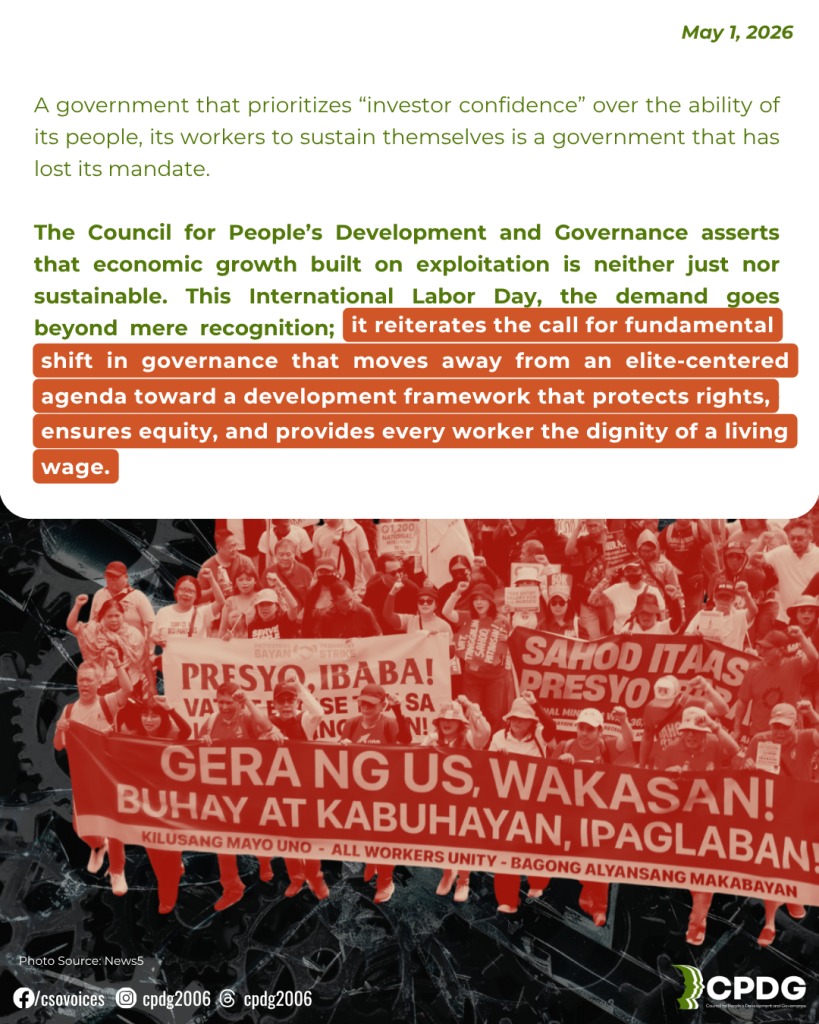
A government that prioritizes “investor confidence” over the ability of its people, its workers, to sustain themselves is a government that has lost its mandate.
True governance requires the immediate realization of the workers’ core demands:
• Enact a National Minimum Wage: Repeal the Wage Rationalization Act (RA 6727) to abolish the regionalized wage trap and move toward a unified ₱1,200 living wage.
• Abolish All Forms of Contractualization: Guarantee security of tenure as a non-negotiable right and stop the “revolving door” of disposable employment.
• Uphold Freedom of Association: End the militarization of workplaces and the criminalization of union organizers to ensure the right to strike and collective bargaining.
• National Industrialization and Land Reform: Address the root of poverty by building local industries and providing land to the tillers, ending the reliance of cheap labor exports.
The Council for People’s Development and Governance asserts that economic growth built on exploitation is neither just nor sustainable. This International Labor Day, the demand goes beyond mere recognition; it reiterates the call for fundamental shift in governance that moves away from an elite-centered agenda toward a development framework that protects rights, ensures equity, and provides every worker the dignity of a living wage.#